Minggu, 14 Desember 2014

Book Review: Ted Seay's Wild Bunch


There are moments in everyone’s development in any role that resonate.  From a father’s first realization to just how closely his young son watches (and sometimes to his horror, mimics) him, to that one positive or negative work experience that cements an attitude that lasts decades.  These moments figuratively fill us with a deep, full, reverberating sound that echoes in our mind’s ears whenever a decision is weighed.  “Remember when…”
This looks cool, but memory crystallization hurts like Hell....

                In my coaching life, one such event struck me in my formative years, the reading of one Ted Seay’s Wild Bunch: A Side Order of Football.  I have previous written about Ted’s concept of Unity of Apparent Intent.

                Ted’s most recent expansion, The Wild Bunch: A Conflict-Theoretical Approach to Offensive Football, is more than a mere re-write.  It is not just an unpacking of the what’s (plays), the how’s (technique), or even the why’s (philosophy)-though it has all of these.  It is a digestion down to the fundamental nature of football:  conflict.
 
                Ted’s mastery at analyzing this concept (on which his newest book wonderfully expounds), coupled with my firm belief that any coach cannot begin his education with fully understanding and owning this concept, has led me to recommend this book for several years to any coach wanting to learn more about offensive football.  Subsequently, dear reader, I also recommend it to you.

                I don’t care if you can diagram every play from Michigan in 1922, or Army in 1945, or Houston 1989, or Kentucky in 1997, or West Virginia in 2005, or Baylor in 2013…..without an understanding of the underlying principle of all these great offenses (beside having talent), you have the directions on how to build a fine sports car, but no idea how to use the tools.

                That underlying principle is conflict.  I mean, if one has the brute force to run wedge every play for no less than 3 yards, then that is exactly what they should do.  In the real world, however, no one is THAT much better than their opponents (and if you are, feel free to stop reading and go back to dusting your trophies).
 

                A conflicted defender is one who lack certainty about where the ball is/is going, and consequentially, where he should be heading.  Have you ever had a team period where the offensive coordinator just tells the offense to “run it again”, and everyone on the scout team hears it?  You never saw a cornerback fill on iso like that kid just did.

                The lack of conflict, and certainty with which the defense could sprint to ball creates very tough sledding, and soon the offensive coordinator is yelling at the scout defense to “play it honest”.

                It should also be noted, that space is a vital component (and in fact, the end goal) of conflict.  Even the phone booth knife fight that is the Double Wing offense wants to eventually get the ball in space.

                Those who doubt that last statement have never played a good DW team with the ability to go play action, and the corner route is so wide open your pregnant wife could throw the touchdown.  Conflict (secondary players needing to help on power) creates space (PAP over the top of flat footed cornerbacks).

                Ted expertly defines this in chapter 3 of his book:                                            


“…….don't take on your opponent at what he does best or where he is most concentrated. Coach Woody Hayes put it very well, misquoting Sun Tzu slightly, but to good effect: "Don't attack walled cities." I would add to that a corollary -- don't attack walled cities while the defenders are fresh and alert. Maneuver past the concentrations of enemy forces into open territory and ride like hell. Force your opponent to redeploy his forces to cover more ground, until you have him stretched thin from sideline to sideline. Then attack the walled city, while its defenders are out in the plains waiting for a cavalry end run that never comes.”
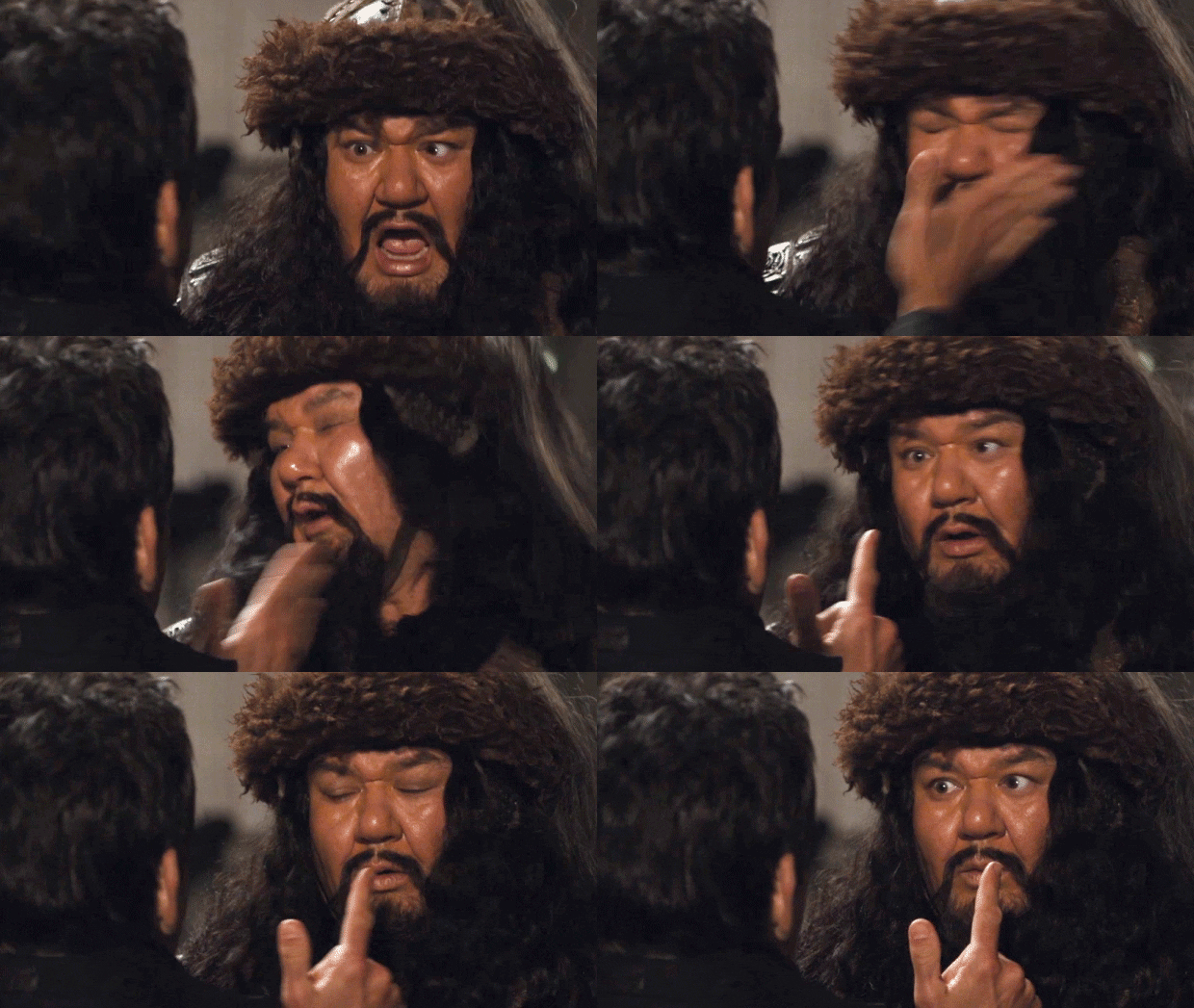

"Don't chase the enemies fly sweep!!  But still stop it somehow!"


                That concept alone is worth buying the book. 

                Ted goes on to lay out the personnel, formational structure, plays, drills, and practice plans associated with his offense, all the while relating his decision making back to the original premise of conflict theory.
                For years I have said this, and with this new edition (which stands apart from the rest), it has never been more true:  I do not care what offensive system you run, this is a MUST READ.

Senin, 04 Agustus 2014

Annals of Cripes!


This blog has been around since 2007 (not really taking off until 2009) and has generated over 4 million views.  Over the years, we've covered a lot of different topics.  The intent has always been to share ideas and collaborate whenever possible.  We hope it's existence has helped you in some way.


As the off-season lull is fading and we're about to ramp up into a new season of high school, college and pro football, here are links to some of the more popular (and exhaustive) coaching studies we've conducted...


NICK SABAN


BO PELINI


ALEX GIBBS


TONY FRANKLIN


Maybe more importantly, we've been trying to keep tabs of where the game is going.  We're hoping to expand on some of initial impressions voiced over the years.  Below are some concepts you may want to watch for in the coming seasons....


DEFENSIVE TRENDS 


Sabtu, 28 Juni 2014

Ground & Pound Passing Game Simplified for your QB


If you do not think playing QB is difficult, I challenge you.  Stand behind your QB in 7 on 7 and actively make decisions with him.  Not only is it difficult to make good decisions, but you then have to do all of the little things right to make an accurate throw.  Do yourself a favor and do that with your QB.  That’s not to mention the role an active rush takes in speeding up those decisions.  Do it with your QB in 11 on 11 and I know you will have a different appreciation for the position.  Now lots of you gurus out there played QB and understand.  I didn’t.  I was a high school linebacker-defensive end-baseball-playin rascal.  However, you give me a marker and a white board and I can draw any and every route combination known to man. Drawing on a board and labeling progressions is something my wife can do (not really but you get the point).

I have worked for three head coaches at one high school in Texas.  For each head coach our emphasis on offense has been to run the football, and we have done it very effectively.  I did say run the football didn’t I?  In my 14 years at Denison High School we have never ever ever ever been close to balanced (50/50). Most years we have been 75/25 run and even more drastic situationally.  One year we were 97% run on 1st down, with the only 1st down passes coming in our initial game script. Now the definition of balanced can be many different things.  My definition of being balanced is being able to throw the football when we want to, not just on 3rdand 8.  There is nothing better than being able to run the ball down your opponent’s throat knowing they have no answer.  If we can, we will.  Balanced in my mind is being able to throw the ball on 1st down, 2nd and 7, 3rd and 1 to help you win games.  To be able to do that, you need options.  Screens, play actions, quick game, drop back are all things that offenses need to be balanced but implementing them efficiently and effectively are often times difficult for a ground-and-pound offense, particularly in training a QB.  In Denison, for all 3 regimes, we have majored in play action and screens.  Of course in clinic talk lingo we have dabbled in quick games and drop back concepts, but the practice time we used developing those skills did not match up to what we were doing on Friday nights.  And of course the limited amount of time delegated for protections (where passing game should start)…..don’t get me started.

The meat-and-potatoes of this article is about developing a consistent base passing game for the benefit of the QB in a run-first offense, particularly a common drop back route concept that ties in progressionally with the majority of your passing game.  As I said before the base of our run-dominant offense passing game has been play actions and screens.  Screens are screens, 95% of the time the lone target is designated pre-snap, with an occasional double-screen mixed in.  There isn’t much for your QB to have to decide here. He knows where the ball is going.  The more screens the better.  Get the ball to your playmakers in space and let them eat up yards on these 0 yard throws and no progression decisions for your QB. 

So back to playing QB…if you are a ground-and-pound offense and your game preparation time (practice/meeting/game plan/video) is focused on the run game, then philosophically make the decision to make your passing game progressions as similar as possible for the QB.  We already talked about the screens and its lack of progression reads, and that leads to the other large chunk of your passing game which should be play actions.  Most play actions are some type of flood/levels concept with eligible receivers in short, medium, and deep passing zones.  From year to year we have changed how we have taught the QB how to read these, and largely those decisions were based on protections.  For instance on a bootleg, if you are true naked protection then your QB has to be prepared to dump the ball quick so his progression on the High-Low box should be short to deep.  If you pull a guard or leave somebody else in to help on the boot protection, this would give your QB a little more time so you could have the option of reading deep to short on the High-Low box.  The majority of the time we have read short to deep, with the ability to change the progression to take a shot with a tagged route if we felt we had it.  The same goes for any type of front side play action.  We will have QB read short to deep, and always have the ability to tag the backside post/shake/go.  Here is a link to a short vid about boot and the backside shot with the same play action.
http://factorialof11.blogspot.com/2011/12/put-some-shine-on-your-boots-bootleg.html


Like I said before, we can draw a million route concepts but how can you effectively and efficiently teach it to your kids with limited game prep time.  We are going to talk about the shallow cross route combination that so many people have ran it gets called the NCAA or All American route.  We have tweaked it to fit our kids to make it as easy to learn as possible and to be able to use from various formations and personnel groups.  The NCAA concept is ran/taught many different ways but to make it easier for our QB we teach the short to deep progression.  Just as in our play action routes, if the flat route (shallow crosser) is open we are going to take it 100% of the time.  We are not trying to fool the defense with our eyes or front shoulder or any other guru talk.  We have less time to teach so the less clutter we can put in the QB’s mind the better.  We teach the crosser to look at the QB if you want the ball.  If you see a cover 2 corner squatting in the flat, it’s best to not look at the QB.  We tell the crosser his decision should be made by the time he gets to the area vacated by the center.  The crossing route is taught as being ran through the feet of the defensive linemen, underneath all linebackers.  It is the first read, but at the same time we want to create a window behind the route to open up the dig route so the “feet of the DL” rule always applies.  We teach the NCAA concept initially from any and all 2 x 2 sets. 
 
We have extremely simple rules.  The tagged receiver is the shallow crosser.  The most inside receiver on the opposite side of the ball has the dig.  On the digs, we teach 12 yards depth but except 10.  We talk about pressing the outside shoulder of the slot-area-defender to create a larger window inside.  If you are open at depth, sit.  If you are covered at depth, keep working flat across the field until you are open.  Simply put, do not get covered.  The other receivers are getting to landmarks on the field.  This is where we differ from most others running the NCAA concept.  Most run a post on the same side as the dig, with a go to the tagged shallow crosser side on the outside. We are going to have 2 receivers get to what we call the “DIVIDE” on their side of the field which is a landmark apexed or splitting the numbers and hash on a NCAA regulation field.  On a federation rules field, you may want to use the hash or a certain number of yards outside the hash as your landmark.  It does not matter the formation or personnel grouping, we will always have a crosser, a dig, and two divides.  In the picture, the 2 outside guys are running glance posts to get to the divide.  If we had tagged an outside guy as the crosser, then the inside guy aligned on his side would run a seam/over to get to the divide.  You do not have to think about whether or not you are running the post or go, just get to the divide.  We want the divide runners to draw deep players and keep them from getting involved with the digs.  The back is involved in protection.  He is going to work linebackers, inside to outside opposite the shallow crossing route, if his LBs do not come, then he releases to the flat on a shoot route. 

The QB from the gun is going to take a BIG 3 drop.  He knows who the tagged route is and his eyes, feet, front shoulder will follow that guy.  If the tagged route gives the QB his eyes, then give him the ball.  If he doesn’t then feet, eyes, shoulders progress to the dig.  If the QB does not like the dig then feet, eyes, shoulders progress to the back.  CROSS, DIG, SHOOT.  CROSS, DIG, SHOOT.  The CROSS-DIG is the High-Low box just like the play action routes.  So the progression is the same for your QB.  It’s a great route versus multiple coverages and as mentioned before you can run it out of any formation.  If you get a safety creeping down on the dig, then tag it someway to give your QB the option of making a DIVIDE his first “glance.”  Teaching it this way has also helped our summer passing league offense which gives a ton of active progression reading reps to your QB.  If you have any questions about how we teach it for 7 on 7 with empty formations or any other questions shoot me an email or look me u on twitter..


@coach_means

Kamis, 01 Mei 2014

The midfielder will soon enter the final two years of his contract and, despite being a regular fixture in the Barca starting XI this season, could be on his way out of Camp Nou


Barcelona are set to put Arsenal and Manchester United on alert by preparing to listen to offers this summer for Cesc Fabregas, Goal understands.

The Barca academy graduate is at a crossroads in his career as he enters the final two years of his contract with the Catalan club in July.

Fabregas was jeered by home supporters during Barcelona's recent 2-1 home victory over Athletic Bilbao and has become a scapegoat for fans during some troubled times for the club on and off the pitch.


VIEW FROM SPAIN
Pilar Suarez | Goal Spain

Cesc Fabregas would love to stay with his beloved Barcelona but the club's fans aren't as keen on the midfielder remaining at Camp Nou.

Under Tata Martino, Fabregas has become a key figure but the 51-year-old could leave the club at the end of the season after a potentially trophyless campaign.

Fabregas has a contract until June 2016 and there has been no suggestion of a new deal for the Spain international thus far, so this summer could present a good chance for Barca to cash in.
Goal has learned that the Spanish giants are now open to the possibility of selling the versatile midfielder, who turns 27 on Sunday, this summer.

The player himself is also said to be ready to consider the possibility of being lured from the club to which he returned in 2011 after controversially leaving for Arsenal as a 16-year-old.

Fabregas is likely to sit down for talks with senior Barcelona officials at the end of the season, when his future and the issue of whether or not he is to be offered a contract extension will be top of the agenda.

The Spain international is on the radar of both United and Arsenal, where he spent eight highly successful years and finished up as club captain.

Both Premier League clubs have been given informal indications that Fabregas could be available, although the player's lengthy association with Barcelona and the politics involved with him leaving would make a move extremely delicate.

United tabled two bids for Fabregas last summer, when former manager David Moyes made no attempt to hide the club's attempt to prise him from Camp Nou.

Arsenal also explored utilising the first-option clause inserted in Fabregas's Barca contract, with Arsene Wenger understood to have talked on the phone "quite a bit" with his former skipper about returning to the club where he blossomed into one of Europe's outstanding young midfielders.

ARSENAL LATEST
8/11 Arsenal are 8/11 with PaddyPower to be Cesc Fabregas's next club
Arsenal have a fixed price on Fabregas's buy-back clause, believed to be €29 million (£23.8m at current currency rates), and, should another club make a concrete offer for the midfielder, Barca would be obliged to inform the Londoners, who would then be given first refusal.

Only Sergio Busquets (43) has started more than Fabregas's 42 matches for Barcelona this season and his tally of 14 assists is the best at the club, while he has also weighed in with 13 goals.

However, Fabregas has often found himself on the bench for the marquee matches during the last three seasons or withdrawn from the team when he starts the key games.

Even though Xavi is 34 and Andre Iniesta turns 30 in June, Barca are ready to consider the possibility of Fabregas leaving as they step up plans to add more pace in their midfield.

Barcelona were eliminated at the quarter-final stage of the Champions League, lost the Copa del Rey final to Real Madrid and currently sit second in La Liga, four points behind leaders Atletico Madrid with three matches remaining.

source: goal.com

Rabu, 30 April 2014

Non Stop Clinic: Ron Roberts Football


With the clinic season over, we've found a real gem to keep you inspired from the staff at Southeastern.  After coming off a whirlwind 11-3 season, Head Coach Ron Roberts has opened his clinic archives at http://www.ronrobertsfootball.com/ to offer a variety of consulting services, skills camps, an active blog and forum, and a trove of valuable clinic videos.

This is an impressive concept that Coach Roberts and staff have launched.  With minimal overhead, they provide superb content without all the marketing and commercialism that has spoiled a great deal of coaching resources.  


Most college staffs facilitate their own clinics, network and share with high school coaches, as well as host skills camps at their facilities. Southeastern has tapped into the accessibility of the Internet and has provided an opportunity for all coaches to take part in these off-season rituals.

I'd highly recommend checking out this site and taking part of this readily available content.

Sabtu, 08 Maret 2014

Get Better

OHIO OPTION CLINIC

We're deep into clinic season and hope you've found some good speakers or programs to visit.  Courtesy of Malone University in Ohio, here is a great analysis of how to structure your concepts (regardless of your offense).


ALL22 NCAA FILM 

Thanks to the grind of all-everything Coach Alex Kirby, you don't have to have a deep library of film to barter with shady back alley traders.  Coach Kirby has launched his library sharing site - http://www.all22video.com/

Yearly and monthly subscriptions are available to check out this collection of NCAA game film.

Minggu, 12 Januari 2014

2014 Resources

ESPN Film Room with Addazzio, Chryst, and Sumlin was a step in the right direction for providing real time analysis of this epic bowl matchup.  Unfortunately, chuckleheads Millen and Spielman ensured the discourse never rose above the Buffalo Wild Wings demographic.